
 MENU
MENUWeekly Column
Each week a small segment of Vernon County history is published in the county papers.
For the week of 10/18/2026
by Kristen Parrott, curator
The annual road tour of Vernon County country schoolhouses will be held this Saturday, October 24. This self-guided tour will visit some of the remaining former country schoolhouses of the area. Some school buildings are now gone, but the tour will indicate the sites where they once stood.
This year’s tour will cover the northwestern part of Vernon County. The route begins in Westby and travels in a loop through the hills and valleys of the Towns of Christiana, Coon, Hamburg, Bergen, Harmony, and Jefferson.
To start the tour, pick up a tour guidebook and map that day, October 24, between 9AM and 1PM at the historic Seas Branch School. The school is located next to Westby Elementary School at 122 Nelson St. in Westby. There is a suggested donation of $10 for the guidebook.
With guidebook and map in hand, you can then drive the tour of about 30 country schoolhouses and sites, enjoying the fall scenery and learning about rural architecture. Each stop will be marked with a little red schoolhouse sign. These signs will stay up until Sunday evening, so after purchasing the guide and map on Saturday morning, you have the rest of the weekend to drive the actual tour.
Recently we were given the diaries of Mattie Jackson Seiler (1888-1953), and volunteers have begun transcribing the entries for 1922, the year that she married. Her obituary indicates that she taught music at the Vernon County Normal School in Viroqua, but in 1922 she was clearly travelling around to the county’s rural schools.
It appears that Mattie was supervising the teachers. The entry for February 1 reads, “Did not go supervising as weather was inclement.” And on Tuesday, March 14, she travelled to La Crosse to attend a Supervising Teachers’ Conference for several days. A few entries indicate that she was also giving standardized tests to the schoolchildren, including arithmetic tests, Rural Diploma tests, and State Graded tests.
Every week lists more schools. On January 10, Mattie went to Round Prairie. On January 11, she went to Lower Weister. On January 17, she went to Liberty Pole and Hinkst. On January 18, she went to Plainview and White Pigeon. And so on.
The diary usually doesn’t list these places as “schools”, but they are all familiar school names. Sometimes she travels with Palma Grahn, Vernon County’s first public health nurse, whose job primarily involved working with rural school children, those who had less access to health care than the city kids. We know that Palma had an office inside the Normal School building, which is now home to our Vernon County Museum and History Center, and it appears that Mattie had an office space here too.
Mattie and her companions travelled to the schools in all weathers. She travelled by train when possible, as on April 5: “Left for Genoa this morn on the first S.E. [Southeastern train]. Got there for dinner. Visited Genoa & Riverside Schools.” And the next day, “Via Burlington [train] to Victory.”
But usually she went by car or buggy or sleigh, often with a driver. On March 6 she writes, “Started out for the country in a Ford, but came back for team.” (She was travelling to Dach Ridge School that day.)
This weekend, you too can have the experience of driving out to see Vernon County’s country schools!
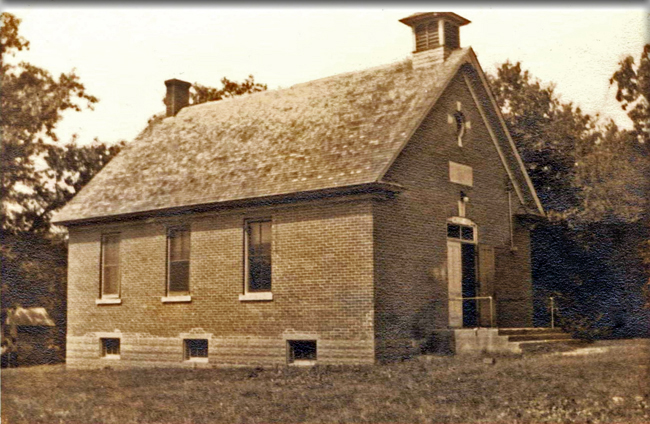
Valley View School, Town of Hamburg, will be on this year’s country schoolhouse tour.

For the week of 10/11/2026
by Kristen Parrott, curator
Dudley, Lepke, Clawson, Baker, Enterprise, Oak Ridge, Cliffside, Valleyview. Do you recognize these names?
They were all names of country schools located in the northwestern part of Vernon County. Our region was once dotted with little country schoolhouses. For about 100 years, from the 1860’s to the 1960’s, the country school was an important part of life in this rural area. Today almost all of the country schools have closed, but often the old buildings are still standing.
Our 6th annual country schoolhouse road tour will be held on Saturday, October 24. This year’s tour covers northwestern Vernon County, including the schools named above plus many more. The self-guided driving tour will lead you past remaining schoolhouses, and past the sites of schools that are now gone.
Start your tour between 9AM and 1PM on October 24 at the historic Seas Branch School, located next to Westby Elementary School at 122 Nelson St. in Westby. For $10, you can pick up the guidebook and map, and then drive along a beautiful route full of fall colors through the Towns of Christiana, Coon, Hamburg, Bergen, Harmony, and Jefferson. The individual sites will be marked with little red schoolhouse signs, which will stay up until Sunday evening.
The Seas Branch School will be open for touring inside that Saturday. The schoolhouse was originally located east of Hwy. Y in the Town of Viroqua. It was near the village of Avalanche, along the Seas Branch of the West Fork of the Kickapoo River. The school was built in 1908 and operated until 1958. After it closed, the building was used for a time by the Seas Branch Smithies 4-H Club. Then in 1998, it was moved to the Westby Area Schools property and restored.
The tour will include about 20 schools. Check out our website or call us at 608-637-7396 for more information.
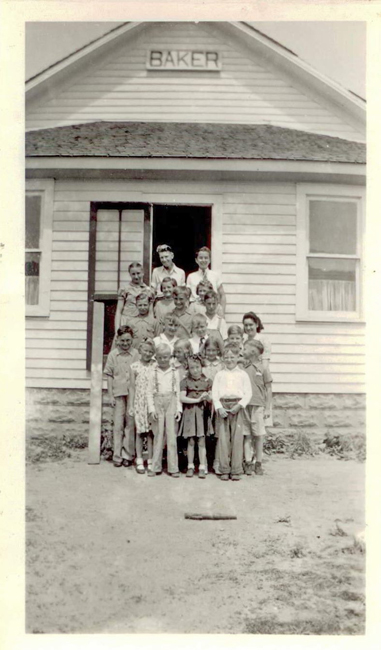
Baker School, Town of Harmony, will be on this year’s country schoolhouse tour.
Pictured here are the schoolchildren in 1941 with teacher Julia Sund.
The previous two articles: