
 MENU
MENUWeekly Column
Each week a small segment of Vernon County history is published in the county papers.
For the week of 9/27/2026
by Kristen Parrott, curator
The first-ever Taste of Norway festival will be held this Saturday, October 3, from 1 to 4PM at the historic Country Coon Prairie Church. The beautiful old church building is located at S2706 Coon Prairie Road, just southeast of Westby. Six local organizations, including our own Vernon County Historical Society, are presenting an afternoon of authentic Norwegian food, music, and history.
In the dining hall downstairs, enjoy samples of sweet and savory Norwegian foods and drinks, and learn about the history of Norwegian immigration to Vernon County and how the culture has been preserved here. In the sanctuary upstairs, listen to musician Eden Ehm of Decorah telling stories and playing her traditional Hardanger fiddle.
Everyone is welcome to attend. This festival is free, but donations are greatly appreciated.
Continuing with the Norwegian theme, on Tuesday, October 6, at 7PM, at the Vernon County Museum and History Center, Civil War reenactor Dave Glomstad of La Crescent will present a program about the 15th Wisconsin Volunteer Infantry, sometimes called the Scandinavian, or Norwegian, Regiment. Many Norwegian immigrants to Wisconsin joined this regiment.
Glomstad’s presentation will focus on men from Bad Axe/Vernon County who were in the 15th. This Wisconsin regiment fought in Civil War battles along the Mississippi River, and in the states of Kentucky and Tennessee, and finally in Georgia in the far south.
Everyone is welcome to attend the presentation. Programs are held in the first-floor conference room, which is handicapped-accessible. Suggested donation of $2.50 person.
Our October genealogy class will also explore the topic of immigrants. On Thursday, October 8, at 10AM, at the museum and history center, Karen Sherry will lead the class in an exploration of immigration records and how they can be useful in learning about your family history.
New students are always welcome to join the class. Vernon County Historical Society members attend for free, and non-members are asked to pay $5 per session.
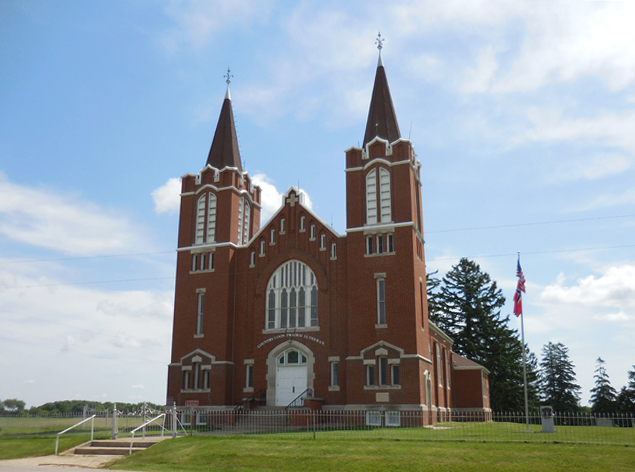
Country Coon Prairie Church will be the site of the
Taste of Norway festival on Saturday, October 3.

For the week of 9/20/2026
by Kristen Parrott, curator
What happened to people long ago who had developmental or intellectual disabilities, or a mental illness, or cerebral palsy, or epilepsy? What happened to those who were paralyzed, or who suffered from alcoholism, or were incapacitated by PTSD? What happened to the very poor who had no money, no family, no friends?
Often they were “institutionalized”, and in Vernon County, the institutions were the county asylum and the county poor house. These two institutions were located at the northeastern edge of the county seat, Viroqua, near the railroad tracks where they crossed County Road BB. The asylum, later called a hospital, and the poor house, earlier called an alms house, were next to each other and surrounded by a farm that supported those who lived there.
And what happened when the residents died? Sometimes their families came for their bodies and buried them among their ancestors. But if no one came, then the residents were buried in a cemetery just north of the asylum.
That cemetery is now called the Vernon County Cemetery, and on Sunday, September 27, the Vernon County Historical Society will host a cemetery walk there at 4PM. Everyone is welcome to attend. We ask for a donation of $5 per person to go on the walk.
The historical figures featured will include Agnes Wilkins, matron of the asylum; Dr. Frank Morley, visiting physician; Millie “Belle” Revels Shivers, asylum resident; and Henry Nagel, asylum resident. Costumed actors will portray each of these people.
To reach the cemetery, go to the intersection of N. Main St. and Co. Rd. BB in Viroqua, and turn east. Drive past Vernon Manor nursing home on your left, then turn left (north) onto County Home Rd., where you see a “Vernon County – Erlandson Building” sign. Go towards the Erlandson Building, then turn right towards the barn. [The insane asylum used to be south of the barn.]
Then turn left again, drive past the police impoundment lot on your left, and head north out onto the dirt road through the farm fields. You will go a short distance past fields of corn and alfalfa until you come to a fenced-in lawn with a few large trees around it, a U.S. flag on a flagpole, and a large stone monument near the entry. This is the cemetery. Cars can park on the mowed grass to the south and west of the fenced-in cemetery.
In case of heavy rain, the event will be held one week later, on October 4. But we’re hoping for beautiful weather on September 27!
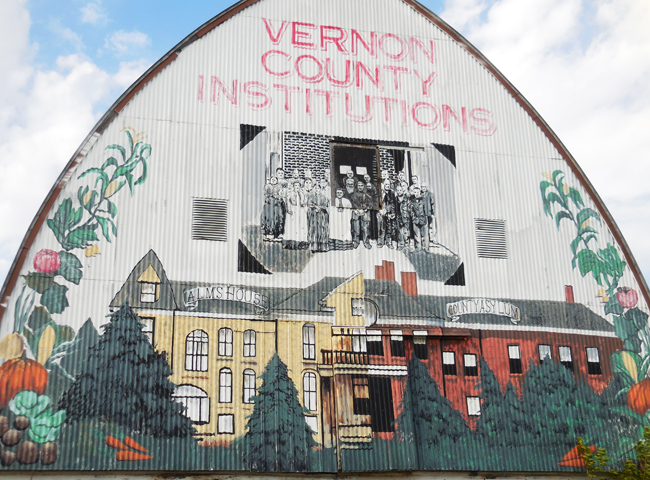
This mural on a nearby barn depicts the Vernon County alms house and
the asylum, and some of the residents who lived there around 1912.
The previous two articles: